
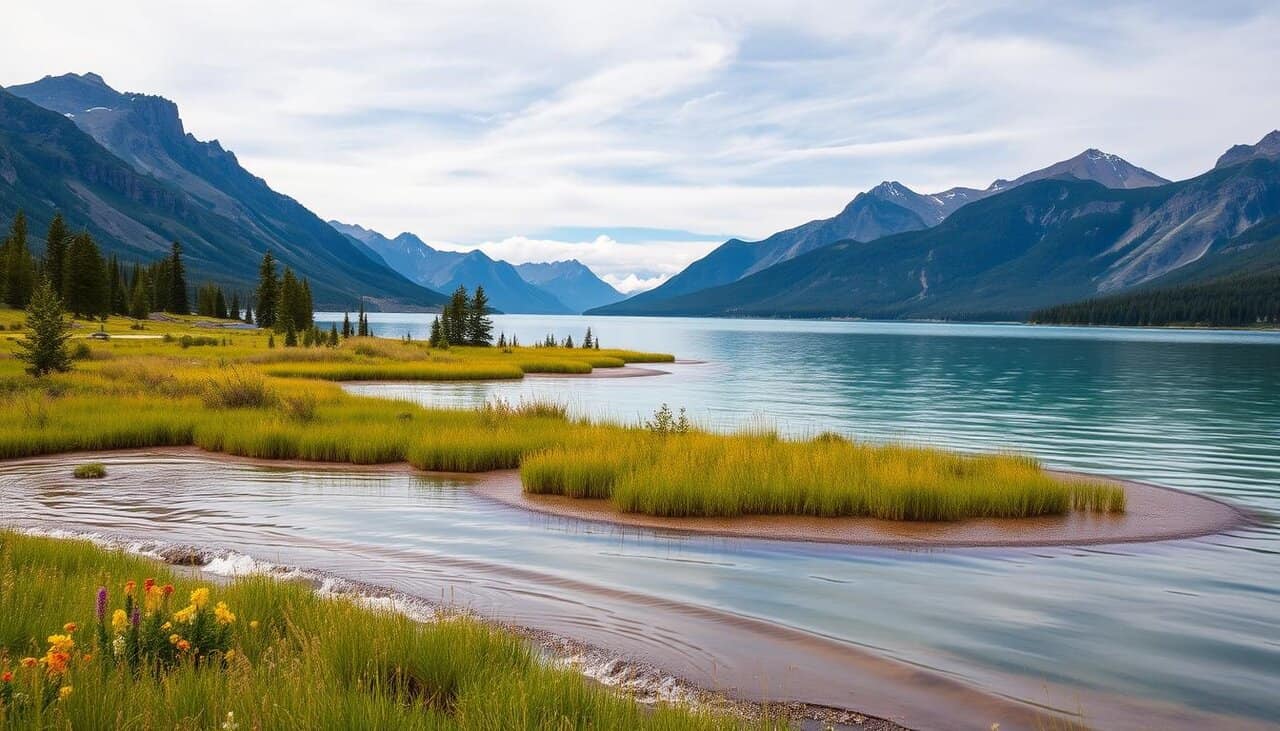
Imagine draining the largest high-elevation lake in North America, Yellowstone Lake. What would you find at the bottom? Recent research by Dr. Val Klump has revealed a surprising landscape that mirrors the park’s famous terrestrial features: geysers, hot springs, and deep canyons.
This astonishing discovery has revolutionized our understanding of Yellowstone‘s hydrothermal system and its potential hazards. Advanced technology has mapped previously unknown features, including massive explosion craters and hydrothermal vents.
These findings provide crucial information into the park’s geological activity and help scientists better understand the complex processes beneath the surface.
Key Takeaways
- Recent research has unveiled a hidden world beneath Yellowstone Lake’s surface.
- The discoveries include geysers, hot springs, and deep canyons similar to those on land.
- Advanced technology has mapped new features such as explosion craters and hydrothermal vents.
- These findings have significant implications for understanding Yellowstone’s geological activity.
- The research has improved our understanding of the park’s hydrothermal system and potential hazards.
The Hidden Underwater World of Yellowstone Lake
Recent studies have dramatically changed our understanding of Yellowstone Lake, exposing a hidden underwater world. As we delve into the lake’s depths, we find that there’s more to it than meets the eye.
Overview of Yellowstone Lake’s Unique Characteristics
Yellowstone Lake is not just any ordinary lake; it’s a body of water with unique characteristics that set it apart. Located withinWyoming’s Yellowstone National Park, the lake is known for its hydrothermal features. The lake’s surface elevation is approximately 7,732 feet above sea level, making it one of the largest high-altitude lakes in North America.
| Characteristics | Description |
|---|---|
| Surface Elevation | 7,732 feet above sea level |
| Location | Yellowstone National Park, Wyoming |
| Notable Features | Hydrothermal features, deep canyons |
Revolutionary Research That Changed Our Understanding
Dr. Val Klump’s research using submersible robots has been revolutionary. The discovery of a 390-foot deep canyon east of Stevenson Island was a significant finding that challenged previous knowledge. Prior to this, the deepest point was believed to be 320 feet at West Thumb. The research also revealed that conditions in parts of Yellowstone Lake are similar to those near deep-sea hydrothermal vents.
Theresearch projecthas opened up new avenues for understanding the lake’s complex underwater environment. By exploring the lake’s depths, scientists have gained insights into the broader geologicalprocessesat play.
Massive Hydrothermal Explosion Craters
One of the most striking features revealed by recent explorations of Yellowstone Lake is the presence of enormous hydrothermal explosion craters. These natural wonders provide a unique insight into the geological processes that have shaped the lake’s underwater landscape.
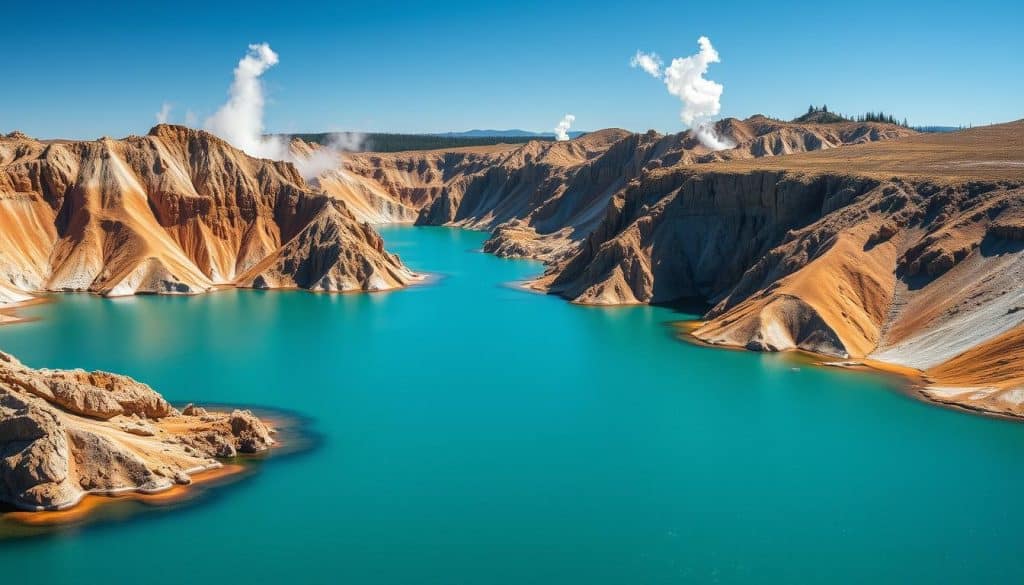
Mary Bay: The Largest Hydrothermal Explosion Crater on Earth
Mary Bay stands out as the largest hydrothermal explosion crater on Earth, a testament to the immense power of the geological forces at play beneath Yellowstone Lake. This massive crater, formed by a cataclysmic event, highlights the complex interaction between water and the lake’s magmatic system. The crater’s size and characteristics offer scientists a fascinating subject for study, shedding light on the processes that drive such explosions.
The formation of Mary Bay and other similar craters is a complex process involving the sudden heating of water derived from rain and snowmelt, hidden beneath the surface. When this water is heated from below, perhaps by a burst of hot gas from a deep magma chamber, it flashes into steam, expanding rapidly and creating an explosive force.
Elliott’s Crater and Other Major Depressions
In addition to Mary Bay, other significant craters such as Elliott’s Crater have been identified on the lake floor. These depressions, formed by hydrothermal explosions, vary in size and characteristics, each providing valuable information about the geological history of the area. The presence of these craters indicates the dynamic nature of the lake’s floor and the ongoing geological processes that shape it.
How These Craters Were Formed
The explosion that creates these craters is powered by the rapid conversion of water to steam, a process that occurs when the delicate pressure balance is disrupted. This disruption can be triggered by various factors, including earthquakes or sudden changes in lake level. As the steam expands, it pries apart subterranean cracks, eventually blowing out holes that widen into craters as the escaping vapor flings rocks and debris into the air.
Understanding these hydrothermal explosion events is crucial for gaining insights into the geological dynamics of Yellowstone Lake and the broader Yellowstone magmatic system. By studying these craters and the processes that form them, scientists can better comprehend the complex interactions between water, steam, and the underlying geological structures.
What was found at the bottom of Yellowstone Lake?
The exploration of Yellowstone Lake’s depths has revealed a fascinating world of hydrothermal activity. As we explore the lake’s bottom, we find a complex landscape shaped by hydrothermal vents and unique geological processes.
Extensive Network of Hydrothermal Vents
One of the most significant discoveries is the extensive network of hydrothermal vents scattered across the lake floor. These vents are crucial in understanding the lake’s ecosystem and geological activity. The vents are part of a larger system that includes hot springs and geysers, indicating a vast, interconnected network beneath the lake.
Scientists believe that these vents represent a key component of Yellowstone’s hydrothermal system, providing insights into the processes that shape the lake’s bottom and influence its water chemistry.
Deep Canyons and Underwater Topography
The lake’s underwater topography is characterized by deep canyons and varied landscapes. These features are a result of millions of years of geological activity, including erosion and tectonic movements. The canyons are significant not only for their depth but also for the information they hold about the lake’s history and the surrounding geology.

Silica Chimneys and Rock Spires
Among the most remarkable discoveries are the silica chimneys and rock spires found on the lake’s floor. Near Mary Bay, hollow silica chimneys rise from the lake bottom, resembling the remnants of an underwater city. These structures are thought to be the preserved plumbing systems of ancient geysers that have since gone dormant.
Near Bridge Bay, researchers found rock spires up to 20 feet tall, formed by minerals precipitating from hot waters over time. These formations provide a unique window into the hydrothermal processes that have shaped the lake.
| Feature | Description | Location |
|---|---|---|
| Silica Chimneys | Hollow, several feet tall, remnants of ancient geysers | Mary Bay |
| Rock Spires | Up to 20 feet tall, formed by mineral precipitation | Bridge Bay |
| Hydrothermal Vents | Part of a larger hydrothermal system, influencing water chemistry | Various locations across the lake |
The North Basin Hydrothermal Dome and Other Pressure Cookers
Yellowstone Lake conceals a complex hydrothermal system, with the North Basin Hydrothermal Dome being a key component. This feature is part of a larger network of hydrothermal activity beneath the lake.
The discovery of such features has significantly advanced our understanding of the lake’s subsurface dynamics. Let’s dive deeper into the formation and structure of these hydrothermal domes.
Formation and Structure of Hydrothermal Domes
Hydrothermal domes, like the one in the North Basin, are formed due to the accumulation of gas and heat from Yellowstone’s hydrothermal system. This process can cause the ground above to inflate or rise. The North Basin Hydrothermal Dome is characterized by its significant size and the presence of numerous hot springs.
Key characteristics of hydrothermal domes include their association with hydrothermal vents and the alteration of surrounding sediments due to thermal activity. These features are indicative of the dynamic processes at play beneath Yellowstone Lake.
| Feature | Description | Significance |
|---|---|---|
| Hydrothermal Domes | Formed by gas and heat accumulation | Indicate hydrothermal activity |
| Hot Springs | Presence of thermal water discharge | Signify subsurface hydrothermal processes |
| Altered Sediments | Chemical changes due to thermal water | Evidence of ongoing hydrothermal activity |
The “Inflated Plain” Controversy
The “inflated plain” refers to a region in the northern part of Yellowstone Lake that was identified as being approximately 2,000 feet long and rising about 100 feet above the surrounding lake floor. Seismic images showed tilted sediments, suggesting uplift due to pressure from below.
The controversy arose when media reports sensationalized the discovery, causing public concern about potential dangers. However, scientists clarified that there was no evidence of recent growth, and temperature measurements showed no changes, indicating stability.
It’s essential to understand that such features are part of Yellowstone’s natural hydrothermal system and do not necessarily indicate imminent danger. However, they do represent areas where future hydrothermal explosions could potentially occur.
Scientific Methods Used to Explore the Lake Bottom
Exploring the depths of Yellowstone Lake has revealed a world of hydrothermal activity and geological wonders. To uncover the secrets of the lake’s floor, scientists employed a range of cutting-edge technologies.
Multibeam Sonar Imaging and Seismic Mapping
Multibeam sonar imaging and seismic mapping were crucial in creating detailed maps of the lake’s topography. These technologies allowed researchers to identify features such as craters and hydrothermal vents. By using multibeam sonar, scientists could map the lake’s floor with high resolution, revealing previously unknown geological features.
Remote-Controlled Submersibles and Core Sampling
Remote-controlled submersibles enabled scientists to explore the lake’s floor directly, collecting samples and observing geological features up close. Core sampling provided valuable information about the lake’s sedimentary history and the presence of hydrothermal activity. For instance, core samples from the Elliott’s Crater site revealed evidence of a massive explosion that occurred around 8,000 years ago.
Key Discoveries That Surprised Scientists
The exploration of Yellowstone Lake yielded several surprising discoveries. One of the most significant findings was that major hydrothermal explosions were not necessarily tied to the retreat of glacial ice, but could be triggered by earthquakes and other mechanisms. For example, evidence from Elliott’s Crater suggested that a magnitude 6.5 earthquake triggered a massive explosion around 8,000 years ago.
| Method | Key Findings |
|---|---|
| Multibeam Sonar Imaging | Detailed maps of lake topography, identification of craters and hydrothermal vents |
| Remote-Controlled Submersibles | Direct observation of geological features, collection of samples |
| Core Sampling | Information about sedimentary history, presence of hydrothermal activity |
These findings have significant implications for our understanding of Yellowstone Lake and its geological history. By continuing to explore and study this unique site, scientists can gain a deeper understanding of the complex processes that shape our planet.
Conclusion: Implications and Future Research
The discoveries beneath Yellowstone Lake have significant implications for understanding the park’s geological hazards. The findings reveal that hydrothermal explosions represent a more immediate risk than the volcanic eruptions that often dominate media coverage.
According to Lisa Morgan, a USGS scientist emerita and volcanologist, large hydrothermal explosions “could very well happen today.” This risk is considered more pressing because, unlike volcanic eruptions, hydrothermal explosions can occur with minimal warning as pressure builds beneath sealed domes on the lake floor or in other hydrothermal areas of the park.
Future research will focus on monitoring known hydrothermal domes, particularly the massive North Basin Hydrothermal Dome, for signs of increased pressure or changes in vent activity. The Yellowstone Volcano Observatory is conducting a comprehensive geologic hazard assessment to help park managers develop safety protocols. For more information on Yellowstone‘s hydrothermal activity, you can visit Science News and learn about Yellowstone National Park. These efforts will enhance our understanding of this dynamic system that has been active for thousands of years.
FAQ
What makes Yellowstone Lake’s hydrothermal system so unique?
Yellowstone Lake’s hydrothermal system is distinct due to its large hydrothermal explosion craters, such as Mary Bay, and an extensive network of hydrothermal vents that discharge hot water and minerals.
How were the hydrothermal explosion craters on the lake floor formed?
The craters were created when superheated water beneath the lake floor suddenly turned to steam, causing massive explosions that blasted out large depressions.
What can be learned from the research conducted on Yellowstone Lake’s floor?
Scientists have gained insights into the lake’s geothermal processes and the structure of its hydrothermal system through the use of advanced technologies like multibeam sonar imaging and seismic mapping.
Are there any other notable features on the lake floor besides hydrothermal vents and craters?
Yes, the lake floor also features deep canyons, silica chimneys, and rock spires, which provide valuable information about the lake’s geological history and hydrothermal activity.
How do the hydrothermal domes, like the North Basin Hydrothermal Dome, form?
Hydrothermal domes are formed when hot water and steam accumulate beneath the lake floor, causing the ground above to bulge upward and create a dome-shaped structure.
What is the significance of the discoveries made in Yellowstone Lake?
The findings have significant implications for understanding the geothermal processes that shape Yellowstone National Park and provide insights into the park’s unique geological features.