
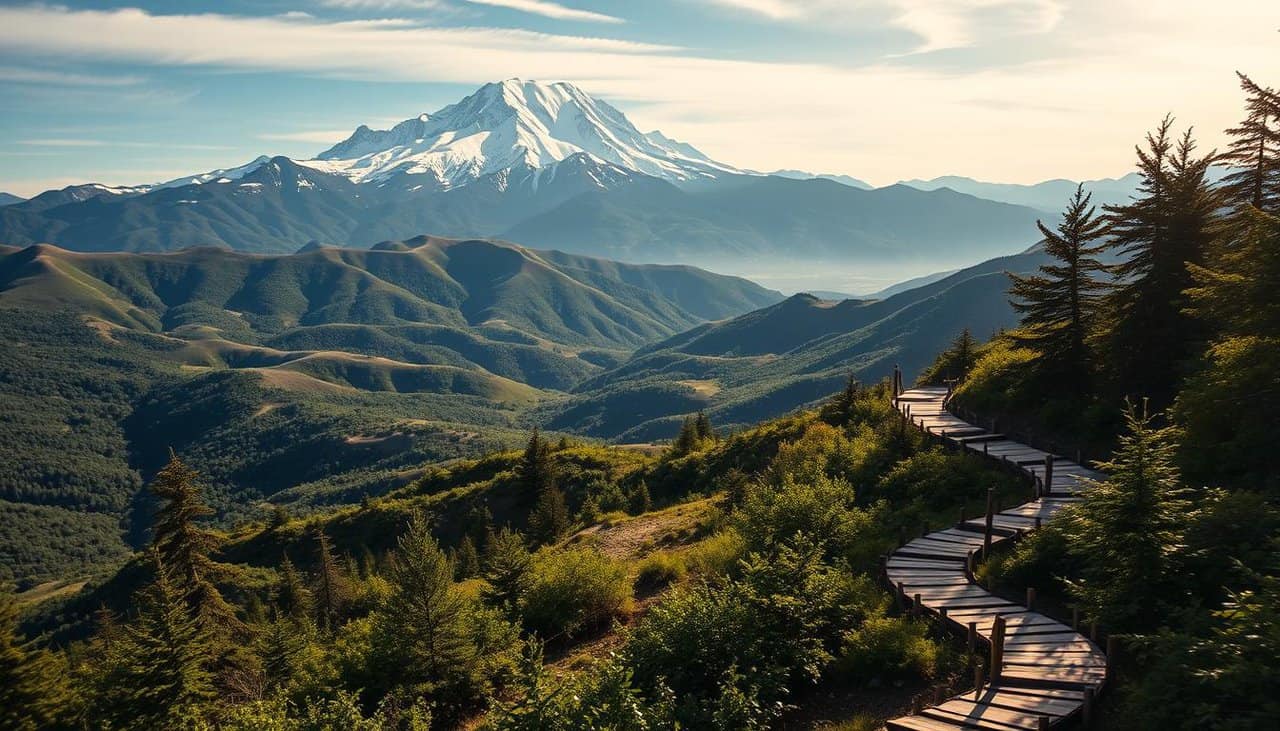
The United States is home to an extensive network of hiking trails that span thousands of miles across diverse landscapes.
For outdoor enthusiasts and adventure seekers, knowing which trail holds the title of “longest hiking-only trail” is valuable information for planning epic journeys.
While several famous long-distance trails crisscross America, not all are exclusively for hikers. This article will explore America’s most magnificent long-distance trails and determine which path holds the title of America’s longest hiking-only trail.
Key Takeaways
- The US has numerous long-distance hiking trails.
- Not all long-distance trails are hiking-only.
- The longest hiking-only trail is a significant adventure.
- Several trails are contenders for this title.
- The Appalachian Trail and Pacific Crest Trail are among the notable long-distance trails.
America’s Magnificent Long-Distance Trails
From mountains to coastlines, America’s magnificent long-distance trails provide endless opportunities for hikers. The US National Trails System is a large network of scenic natural byways that crisscross all over the country, offering recreation opportunities for tourists and much-needed environmental protection to sensitive ecosystems.
These trails are not just pathways; they are gateways to experiencing the diverse natural beauty of the US. They traverse through mountains, deserts, forests, and coastlines, providing hikers with a wide range of landscapes to explore.
What Makes a Trail “Hiking-Only”
The concept of a “hiking-only” trail refers to pathways designed exclusively for foot travel. This designation prohibits bicycles, horses, ATVs, and other forms of transportation that might be allowed on multi-use trails.
Hiking-only trails offer several benefits, including preserving trail conditions, reducing erosion, and creating a more peaceful wilderness experience. They also provide specific challenges for dedicated hikers who seek to immerse themselves in nature.
| Trail Characteristics | Hiking-Only Trails | Multi-Use Trails |
|---|---|---|
| Allowed Usage | Foot travel only | Foot travel, bicycles, horses, ATVs |
| Trail Conditions | Generally well-preserved | May be subject to erosion |
| Hiker Experience | More peaceful, immersive | May be less peaceful due to other users |
Some trails may be hiking-only for certain sections while allowing other uses in different areas. This complexity makes the classification of the “longest hiking-only trail” somewhat challenging.
The Appalachian Trail: America’s Longest Hiking-Only Trail
As the longest hiking-only trail in the US, the Appalachian Trail offers an unparalleled adventure. Spanning approximately 2,190 miles from Springer Mountain in Georgia to Mount Katahdin in Maine, it passes through 14 states along the eastern United States.
The Appalachian Trail is not just a trail; it’s an experience that tests one’s endurance and connects you with nature like never before. The trail extends 2,174 miles, gaining elevation from 124 feet in Bear Mountain State Park to 6,643 feet over Clingman’s Dome. What makes it unique is that it doesn’t cross any highways or roadways, making it the longest hiking-only trail.
History and Development
The Appalachian Trail was conceived in 1921 by Benton MacKaye and completed in 1937. It was built primarily by private citizens and volunteers who envisioned a continuous footpath along the Appalachian Mountains. The trail’s development was a remarkable feat of cooperation between hiking clubs, government agencies, and thousands of volunteers who continue to maintain it today.
In 1968, the National Trails System Act designated the Appalachian Trail as the nation’s first National Scenic Trail, providing federal protection and recognition. The Appalachian Trail Conservancy (ATC) works in partnership with the National Park Service to manage, protect, and promote the trail as a natural and cultural resource.
Key Features of the Appalachian Trail:
- The trail spans 14 states, offering diverse landscapes and ecosystems.
- There are over 250 campsites and shelters along the way, as well as several trail towns where locals offer assistance to hikers.
- The AT’s unique status as a hiking-only trail has helped preserve its character and made it the premier long-distance hiking trail in America.
- Of the many species of flora and fauna found on this trail, 2,000 are endangered, highlighting the importance of conservation efforts.
The Appalachian Trail is more than just a hiking trail; it’s a journey through America’s rich natural and cultural heritage. As you hike through its vast landscapes, you’re not just walking; you’re experiencing the history, the beauty, and the challenges that this trail has to offer.
The Pacific Crest Trail: A Close Contender
As one of America’s most renowned trails, the Pacific Crest Trail offers an unparalleled hiking experience. The Pacific Crest Trail is a long-distance hiking trail that spans 2,650 miles from the Mexican border near Campo, California to the Canadian border near Manning Park, British Columbia.
The Pacific Crest trail stretches 2,638 miles, running along the highest points of the Sierra Nevada and Cascade mountain ranges. Beginning almost in Mexico, the Pacific Crest ends in Manning Park of British Columbia, Canada.
Trail Characteristics and Route
The trail’s characteristics and route make it a unique and challenging adventure for hikers. The Pacific Crest Trail was established in 1968 as part of the National Trails System Act. It takes hikers through 25 national forests, 7 national parks, and numerous wilderness areas along the Sierra Nevada and Cascade mountain ranges.
Unlike the Appalachian Trail, the Pacific Crest Trail allows horses and pack animals on certain sections, which technically disqualifies it from being considered a “hiking-only” trail. The PCT features more dramatic elevation changes than the Appalachian Trail, with hikers experiencing everything from scorching deserts at near sea level to alpine passes exceeding 13,000 feet in the Sierra Nevada.
The trail’s diverse ecosystems include the Mojave Desert, Sierra Nevada alpine zones, volcanic landscapes of the Cascades, and the temperate rainforests of Washington state. While slightly longer than the Appalachian Trail at 2,650 miles compared to the AT’s 2,190 miles, the Pacific Crest Trail’s allowance of equestrian use prevents it from claiming the title of “longest hiking-only trail.”
Nonetheless, it remains a premier destination for long-distance hikers and outdoor enthusiasts. The Pacific Crest Trail’s unique features and challenging terrain make it an exciting adventure for those who dare to take on the journey.
The Continental Divide Trail: The Most Rugged of the Triple Crown
Stretching 3,100 miles along the Continental Divide, this trail is a true adventure. The Continental Divide Trail (CDT) is a journey through some of America’s most breathtaking landscapes, from the rugged Rocky Mountains to the serene desert landscapes.
As you hike along the CDT, you’ll traverse five states: New Mexico, Colorado, Wyoming, Idaho, and Montana. This trail is not for the faint of heart; it’s considered the most rugged and challenging of the “Triple Crown” of long-distance hiking trails.
Unique Features and Challenges
The CDT is a multi-use trail, allowing not only hikers but also mountain biking on certain sections and equestrian use throughout much of its length. This trail passes through 25 national forests, 21 wilderness areas, 3 national parks, and 1 national monument, showcasing incredible ecological diversity.
As of 2023, the CDT is approximately 95% complete, with some sections still following roads or requiring detours. As “The CDT is a true test of endurance and navigation skills,” says an experienced hiker.
The trail’s rugged nature means that hikers need to be well-prepared. You’ll need to navigate through primitive and unmarked sections, making navigation skills essential.
- The CDT spans approximately 3,100 miles from the Mexican border to the Canadian border.
- It traverses through diverse landscapes, including glacial valleys and the rocky Needle Mountains.
- The trail is not just for hikers; it’s a multi-use trail that allows mountain biking and equestrian use.
With its challenging terrain and diverse landscapes, the Continental Divide Trail is a true adventure for any hiker. As you plan your journey, remember that this trail is a test of your endurance and navigation skills.
North Country Trail: America’s Longest National Scenic Trail
As the longest National Scenic Trail in the US, the North Country Trail offers an unparalleled hiking experience. Spanning approximately 4,600 miles, this trail is a testament to the natural beauty and diversity of America’s landscapes.
The North Country National Scenic Trail (NCT) stretches from eastern New York to central North Dakota, traversing eight states along the way, including New York, Pennsylvania, Ohio, Michigan, Wisconsin, Minnesota, North Dakota, and Vermont. This extensive journey showcases the diverse landscapes of America’s northern tier, featuring the Great Lakes shorelines, northern forests, and prairie grasslands.
The 4,600-Mile Journey
The NCT is not just a trail; it’s a journey through America’s heartland. It winds through 12 National Forests, open grasslands, and alongside running rivers, offering hikers a unique blend of ecological diversity. With several trail towns along the way, hikers can rest and replenish their supplies, making the journey more manageable and enjoyable.
While the North Country Trail is not considered “hiking-only” due to certain sections permitting mountain biking and horseback riding, it still offers an incredible experience for hikers. The trail connects over 160 public lands, including national forests, parks, wildlife refuges, state parks, and local recreation areas.
Established in 1980 as part of the National Trails System, the NCT is still under development. Approximately 3,100 miles are currently completed as dedicated off-road trail, with other sections following roads or temporary connectors. The North Country Trail Association works tirelessly with the National Park Service and hundreds of volunteers to build, maintain, and promote the trail.
As you embark on this journey, you’ll experience the rich natural beauty and diverse landscapes that America has to offer. The North Country Trail is more than just a trail; it’s an adventure waiting to happen.
American Discovery Trail: Coast to Coast Adventure
The American Discovery Trail stands out as the only coast-to-coast non-motorized recreational trail in the US. Spanning approximately 6,800 miles, it connects Cape Henlopen State Park, Delaware, to Point Reyes National Seashore, California. As you embark on this journey, you’ll traverse through 15 states and Washington D.C., experiencing a diverse range of landscapes and cultural heritage.
The trail is not just a path; it’s an experience that weaves through urban centers, small towns, and wilderness areas. It’s designed for multiple uses, including hiking, biking, and horseback riding. This multi-use aspect is a defining characteristic of the American Discovery Trail, making it a unique recreational opportunity.

Northern and Southern Routes
TheAmerican Discovery Trailoffers two main routes: the Northern Route and the Southern Route. The Northern Route stretches for 4,834 miles through the Midwest states, including Iowa, Nebraska, and northern Colorado. In contrast, the Southern Route covers 5,057 miles, passing through Kentucky, Missouri, Kansas, and southern Colorado. Both routes offer distinct experiences, with varying landscapes and cultural encounters.
- The trail passes through 14 national parks and 16 national forests.
- It visits over 10,000 sites of historic, cultural, and natural significance.
- The trail connects hundreds of local trails, rail-trails, and greenways.
As you explore the American Discovery Trail, you’ll discover the rich tapestry of American landscapes and heritage. Whether you’re hiking, biking, or horseback riding, this trail promises an adventure of a lifetime.
Eastern Continental Trail: Connecting North America
The Eastern Continental Trail is a remarkable 5,400-mile journey from Key West, Florida to Belle Isle, Newfoundland. This extensivetrailnetwork connects the eastern United States and Canada, offering hikers a diverse range of landscapes and ecosystems.
As you embark on this adventure, you’ll traverse through 16 U.S. states and 5 Canadian provinces. TheEastern Continental Trail (ECT)is not a single designated path but rather a concept that links existing trails, including the Florida Trail, the Appalachian Trail, and the International Appalachian Trail, into one continuous route.
From Florida to Canada
The ECT stretches from the tropical Florida Keys to the boreal forests of Newfoundland, providinghikerswith an incredible diversity of landscapes. While some sections, like the Appalachian Trail, arehiking-only, others allow multiple uses, making the complete ECT a mixed-use route. The trail reaches its highest point at Clingman’s Dome in the Great Smoky Mountains, with anelevationof 6,643feet.
Completing the entireEastern Continental Trailtypically takes 8-12 months. Only a small number ofhikershave completed the entire route since its conceptualization in the late 1990s. Along the way, you’ll find various accommodations, including hotels, hostels, and campgrounds, making the journey more accessible.
Thecontinental trailspans over 5,400miles, offering an epic adventure for those who dare to take it on. Whether you’re a seasoned hiker or just starting out, the Eastern Continental Trail is an experience like no other.
Great Western Loop: The Ultimate Challenge
The Great Western Loop is not just a trail; it’s an odyssey that weaves through some of America’s most breathtaking landscapes. Spanning over 6,800 miles, this ambitious route combines portions of five long-distance trails: the Pacific Crest Trail, Pacific Northwest Trail, Continental Divide Trail, Grand Enchantment Trail, and Arizona Trail.
As you embark on this journey, you’ll traverse nine western states, including California, Oregon, Washington, Idaho, Montana, Wyoming, Colorado, New Mexico, and Arizona. The loop is a true test of endurance, passing through diverse terrains such as the Mojave and Sonoran Deserts, 12 National Parks, and approximately 75 wilderness areas.
Combining Major Western Trails
The Great Western Loop is a complex route that incorporates sections of well-known trails, offering hikers an incredible sampling of western ecosystems. From desert landscapes to alpine environments, the diversity of this trail is unmatched. However, it’s worth noting that the Great Western Loop is not a hiking-only route; it permits equestrian use, mountain biking, and includes sections that follow roads.
To give you a better understanding of what this trail entails, here’s a breakdown of its key features:
| Feature | Description |
|---|---|
| Total Distance | Approximately 6,800 miles |
| States Traversed | 9 (California, Oregon, Washington, Idaho, Montana, Wyoming, Colorado, New Mexico, Arizona) |
| National Parks | 12 |
| Wilderness Areas | Approximately 75 |
| First Completion | Andrew Skurka in 2007 (208 days) |
The Great Western Loop remains one of the most challenging long-distance hiking routes in North America. With extreme weather conditions, remote terrain, and significant logistical challenges, only one person has ever completed this trail. If you’re an experienced hiker looking for the ultimate adventure, the Great Western Loop is a challenge worth considering.
Which is the longest hiking only trail in the US? Analyzing the Contenders
Among America’s extensive network of trails, one question remains: which is the longest hiking-only trail? To answer this, we must first define what constitutes a “hiking-only” trail and then examine the contenders.
The definition of a hiking-only trail is crucial in determining the longest one. A true hiking-only trail is designed exclusively for foot travel, prohibiting bicycles, horses, ATVs, snowmobiles, and other forms of transportation throughout its entire length. This distinction is essential in evaluating the various long-distance trails across the US.
Defining “Hiking-Only”
A hiking-only trail is characterized by its management and regulations. For instance, the Appalachian Trail is managed specifically as a footpath, with regulations that prohibit bicycles and motorized vehicles along its entire 2,190-mile length. Although some sections technically permit horseback riding, in practice, it is designed, maintained, and used almost exclusively by hikers.
The Appalachian Trail’s unique design features, such as narrow treadway, steep sections with stone steps, and low-clearance shelters, further reinforce its status as a trail built specifically for hikers. In contrast, other long-distance trails like the Pacific Crest Trail, Continental Divide Trail, North Country Trail, and American Discovery Trail allow multiple uses on significant portions of their routes, disqualifying them from being considered the longest hiking-only trail.
- The Appalachian Trail is the longest hiking-only trail due to its exclusive design for foot travel.
- Other trails, while long, permit multiple uses such as horseback riding and bicycling.
- The definition of hiking-only is critical in evaluating long-distance trails.

In conclusion, when analyzing the contenders for the longest hiking-only trail in the US, the Appalachian Trail stands out due to its management, design, and exclusive use by hikers. Its 2,190-mile length makes it not only a significant trail but also the longest dedicated to hikers alone.
Preparing for a Long-Distance Hiking Adventure
The journey of a thousand miles begins with a single step, but for long-distance hikers, it’s the preparation that makes all the difference. As you consider tackling a long-distance trail, you’ll need to prepare yourself for the challenges ahead, from physical demands to mental toughness.
To start, it’s crucial to select the right gear for your adventure. This includes a properly fitted backpack, weather-appropriate shelter, a sleeping system rated for expected temperatures, water filtration systems, and clothing layers that can adapt to changing conditions. Each piece of gear should be lightweight yet durable to withstand the rigors of the trail.
Planning Your Adventure
Planning is just as important as the right gear. This involves detailed research about the trail, including water sources, resupply points, potential hazards, and seasonal considerations. Most successful long-distance hikers spend months preparing physically with progressively longer hikes while carrying loaded packs. This conditioning helps your body adapt to the demands of walking 15-20 miles daily for weeks or months.
Mental preparation is equally important. Long-distance hiking presents psychological challenges, including loneliness, discomfort, and the need to persevere through difficult conditions. Many hikers find it helpful to connect with trail communities online, read trail journals from previous hikers, and possibly attend workshops offered by organizations like the Appalachian Trail Conservancy. Understanding Leave No Trace principles and proper trail etiquette is also essential for preserving these natural resources.
By carefully preparing for your long-distance hiking adventure, you’ll be better equipped to handle the challenges that come your way, ensuring a more enjoyable and successful journey.
The Future of America’s Long Trails
The long trails of America are not static entities; they are dynamic pathways that continue to evolve. Recently, three national scenic trails became national park sites in late 2023, doubling the number of long-distance scenic trails in the National Park System. Now, six scenic trails stretch through multiple states, totaling more than 9,200 miles across varying landscapes and hundreds of communities.
America’s long-distance trail system continues to evolve with ongoing expansion projects and new trail designations. The 2023 designation of additional National Scenic Trails as official units of the National Park System has elevated their status and potentially increased funding and protection.
Trail Expansion Projects
Trail organizations are working tirelessly to close gaps in existing routes. For instance, the North Country Trail’s Vermont extension and the Continental Divide Trail’s effort to move sections off roads and onto dedicated pathways are significant ongoing projects. These efforts not only enhance the hiking experience but also contribute to the overall development of the national trails system.
As we move forward, it’s clear that volunteers will remain the backbone of trail maintenance and development. With thousands contributing hundreds of thousands of hours annually, their role is indispensable in keeping America’s long trails accessible and sustainable.
Conclusion
After delving into the world of long-distance hiking trails, a clear champion emerges: theAppalachian Trail. Spanning approximately 2,190 miles from Georgia to Maine, this iconic trail is America’s longest hiking-only trail. While other trails, such as the 4,600-mile North Country Trail and the 6,800-mile American Discovery Trail, may be longer, they allow multiple uses including bicycling and horseback riding on certain sections.
The Appalachian Trail’s unique status comes from its consistent management as a footpath, designed specifically forhikers. Features like narrow treadways, steep stone steps, and low-clearance shelters naturally discourage other uses, preserving its character as a wilderness footpath.
As a unit of theNational Park System, the Appalachian Trail has been preserved through the dedicated stewardship of the Appalachian Trail Conservancy and thousands ofvolunteers. This trail represents not just a physical path but a cultural institution that has inspired generations ofhikersand outdoor enthusiasts since its completion in 1937.
Whether you’re planning a weekend hike or a thru-hike, the Appalachian Trail offers an unparalleled opportunity to experience the eastern wilderness on foot. As America’s trail system continues to evolve, the Appalachian Trail stands as a testament to what can be accomplished whenpeoplecome together to create and protect a pathway through the wilderness for future generations.
The Appalachian Trail is a true national treasure, stretching through 14 states and offering a unique hiking experience. With its rich history and natural beauty, it remains a must-visit destination for any serious hiker or outdoor enthusiast.
FAQ
What is America’s longest national scenic trail?
The North Country Trail is considered America’s longest national scenic trail, spanning over 4,600 miles across seven states.
How long is the Appalachian Trail?
The Appalachian Trail stretches for approximately 2,190 miles from Georgia to Maine, making it one of the most iconic long-distance hiking trails in the US.
What are the characteristics of a "hiking-only" trail?
A hiking-only trail is typically a path that is designed exclusively for hikers, with minimal to no usage by other activities like biking or horseback riding.
How many miles of the Pacific Crest Trail are within national parks?
The Pacific Crest Trail passes through 33 federally mandated wilderness areas and 24 national parks, with a significant portion of its 2,659 miles within these protected areas.
What is the Continental Divide Trail, and how long is it?
The Continental Divide Trail is a 3,100-mile trail that spans from New Mexico to Montana, following the Continental Divide along the Rocky Mountains.
Are there different routes on the American Discovery Trail?
Yes, the American Discovery Trail has both northern and southern routes, offering hikers a choice of paths for their coast-to-coast adventure.
How do volunteers contribute to the maintenance of national scenic trails?
Volunteers play a crucial role in maintaining national scenic trails by participating in trail cleanups, construction, and maintenance projects, ensuring these trails remain accessible and enjoyable for hikers.
What is the elevation range like on long-distance hiking trails?
Long-distance hiking trails, such as the Pacific Crest Trail, can have significant elevation changes, with some sections reaching high mountainous terrain and others passing through lower valleys.