
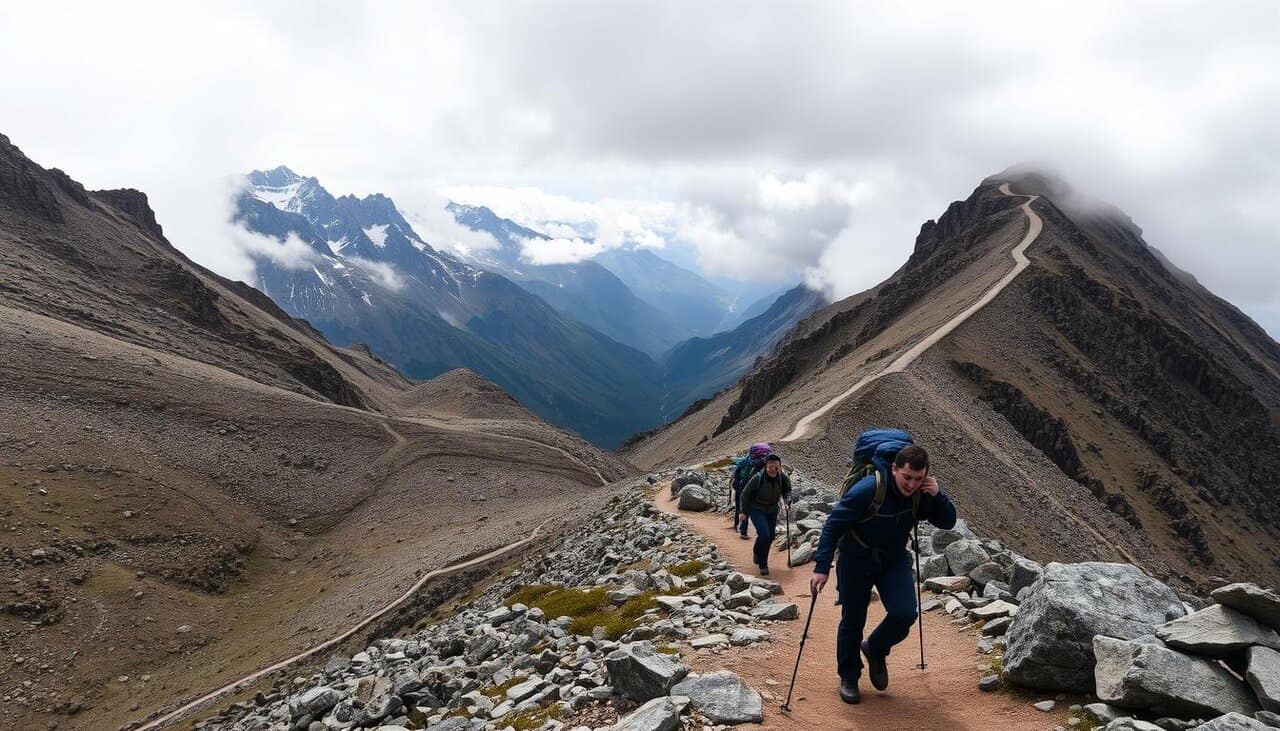
Imagine undertaking a hiking journey so daunting that only a handful of people have ever completed it. Walking the length of the Grand Canyon in one continuous push is one such challenge that has been accomplished by merely 12 individuals.
The world’s most demanding hikes are not just about the distance; they’re about navigating through unmarked terrain, facing extreme weather, and pushing your physical limits to the extreme. These adventures are for those who seek to test their endurance in the most unforgiving environments.
Such trails are not for the faint of heart. They require meticulous planning, specialized skills, and an unyielding spirit. As we explore these incredible journeys, you’ll understand what makes a hike truly one of the most challenging.
Key Takeaways
- The world’s hardest hikes are characterized by their remoteness and lack of infrastructure.
- These hikes demand a high level of physical fitness and mental toughness.
- Navigation through unmarked terrain is a significant challenge.
- Extreme weather conditions add to the difficulty.
- Specialized skills, such as technical climbing, are often required.
Defining Extreme Hiking Challenges
The world’s toughest trails demand a unique blend of physical and mental toughness. One such example is the Snowman Trek in Bhutan, considered one of the most challenging treks in the world. Spanning 217 miles (350 km), this journey takes around 25-30 days to complete, beginning in the district of Paro and passing through lush forests and nine high-altitude passes.
Physical vs. Technical Difficulty
Extreme hiking challenges like the Snowman Trek involve both physical endurance and technical skills. Hikers must be prepared for high altitudes, reaching as high as 16,100 feet (4,908 meters), and navigate through challenging terrains. The physical demands are significant, but technical difficulties such as navigating steep paths and unpredictable weather conditions also play a crucial role.
Environmental Factors
Environmental factors significantly amplify the difficulty of extreme hikes. Unpredictable weather patterns, high-altitude environments, and remote wilderness areas all contribute to the challenge. For instance, hikers on the Snowman Trek face isolation from rescue services, requiring them to be self-sufficient for days or even weeks. Seasonal conditions create narrow windows of opportunity for attempting certain trails, with factors like monsoon seasons and extreme temperatures limiting access.
What’s the Hardest Hike in the World? Experts Weigh In
The notion of the hardest hike in the world is complex and multifaceted. When considering what makes a trail exceptionally challenging, several factors come into play.
The GR20, a long-distance trek in Corsica, is often cited as one of the toughest hikes globally. This 180 km trek traverses the island’s mountainous interior, featuring steep ridges and mountain passes over 2,000 meters high. Completing the GR20 takes about 15 days and involves a total elevation gain of 12,000 feet, equivalent to climbing Mount Everest from base camp.
Criteria for Difficulty Assessment
Assessing the difficulty of a hike involves considering multiple factors. These include physical demands, technical difficulty, and environmental conditions. Trails that stand out for their challenge often combine these elements in unique ways.
For instance, the GR20 is not just physically demanding but also requires technical hiking skills due to its rugged terrain and unpredictable weather conditions.
Why These Trails Stand Apart
The world’s most challenging trails are distinguished by their multifaceted nature. They require hikers to possess a broad range of skills and to be prepared for various challenges.
| Trail | Distance | Elevation Gain | Duration |
|---|---|---|---|
| GR20 | 180 km | 12,000 feet | 15 days |
| Other Notable Trails | Varies | Varies | Varies |

These trails are not just physically demanding; they also pose significant mental challenges due to their remote nature and the need for self-sufficiency.
By examining the characteristics of trails like the GR20, we can better understand what makes a hike truly challenging and how to prepare for such adventures in the world of extreme hiking.
The Snowman Trek: Bhutan’s Ultimate Challenge
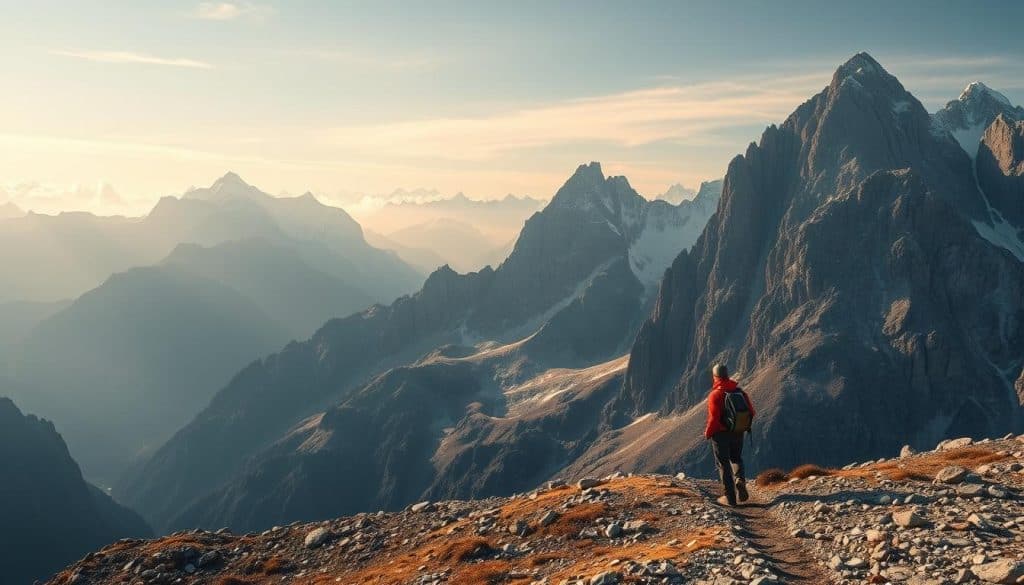
For experienced hikers, the Snowman Trek in Bhutan presents an ultimate challenge that combines high altitude, unpredictable weather, and remote wilderness. This 217-mile journey spans 25-30 days, testing not only your physical stamina but also your mental resilience.
25-Day Journey Across 11 High Passes
The Snowman Trek is a formidable adventure that takes you across 11 high passes, offering breathtaking views of the Himalayas. As you traverse through rugged terrain and remote villages, you’ll experience the unspoiled beauty of Bhutan’s mountains and peaks. The trek demands a high level of physical fitness and acclimatization to high altitudes.
Weather Challenges and Remote Terrain
The trek is notorious for its unpredictable weather, with sudden snowstorms possible even in October, the optimal trekking month. Hikers must be prepared for extreme conditions, carrying appropriate gear for winter. The remoteness of the terrain means that navigation can be challenging, with limited trail markings and paths often obscured by snow or landslides.
Despite these challenges, the Snowman Trek rewards hikers with unparalleled views of pristine Himalayan peaks and cultural experiences in regions largely untouched by outside influence. It’s an adventure that immerses you in the world’s most spectacular landscapes.
Grand Canyon Thru-Hike: America’s Hidden Monster

The Grand Canyon, one of the world’s most iconic natural wonders, holds a secret: a thru-hike that’s as challenging as it is breathtaking. As someone who’s tackled their fair share of backcountry adventures, I can attest that planning and executing this journey is no trivial feat.
Planning and prepping for any major backcountry adventure, whether it’s the Appalachian Trail, Pacific Crest Trail, or a section hike below the rim of the Grand Canyon, is logistically challenging. You must rely on information gathered from numerous sources, from Google Earth to the people who first explored the area.
700 Miles of Trailless Wilderness
The Grand Canyon thru-hike spans nearly 700 miles of rugged terrain, much of it trailless. This isn’t a straightforward hike; it requires navigating through remote landscapes where the route is not always clear.
Cache logistics become a critical planning element, with hikers needing to place food and water supplies at strategic points along the route, often requiring separate hiking trips before the main journey.
Technical Scrambling and Extreme Isolation
Technical scrambling in the Grand Canyon frequently involves navigating exposed ledges and climbing near-vertical pour-offs. The extreme isolation of the route means hikers might go days without encountering another person, creating both psychological challenges and serious safety implications if injuries occur.
The multi-sport nature of this adventure demands proficiency in traditional hiking, scrambling, route-finding, and even technical climbing skills up to low fifth-class in some sections. Daily water planning is essential, with hikers sometimes needing to carry up to three days’ worth between reliable sources.
The Complete GR20: Europe’s Toughest Trek
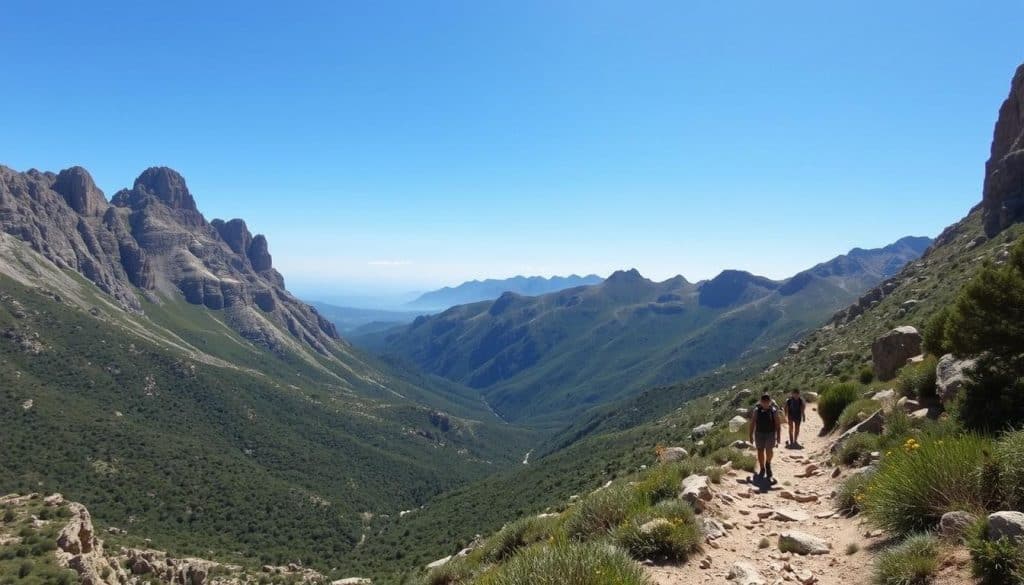
For those seeking a challenge, the GR20 in Corsica is Europe’s toughest trek, offering breathtaking views and grueling terrain. Spanning 180km from Calenzana to Conca, this trek is not for the faint of heart.
180km of Rugged Mediterranean Terrain
The GR20 traverses rugged mountainous terrain, with hikers facing a series of scrambling maneuvers that test their technical skills. As you trek through dramatic coastline and mountain villages, the landscape unfolds in ways that only reveal themselves to those who dare to take on this challenge.
12,000m of Elevation Change
The trek’s staggering 12,000 meters (39,370 feet) of cumulative elevation change is equivalent to climbing from sea level to the summit of Mount Everest and halfway back down again. This relentless up-and-down profile means that hikers rarely experience flat terrain, with each day involving multiple steep ascents and descents over rocky, technical ground.
Many hikers underestimate the GR20’s difficulty based on its relatively short distance, only to find that the combination of technical terrain and constant elevation change requires significantly more time and energy than anticipated. Successful completion of this trek requires careful pacing and energy management, making it essential for trekking enthusiasts to be well-prepared.
Mugu Reconnaissance Trek: Nepal’s Great Himalaya Trail
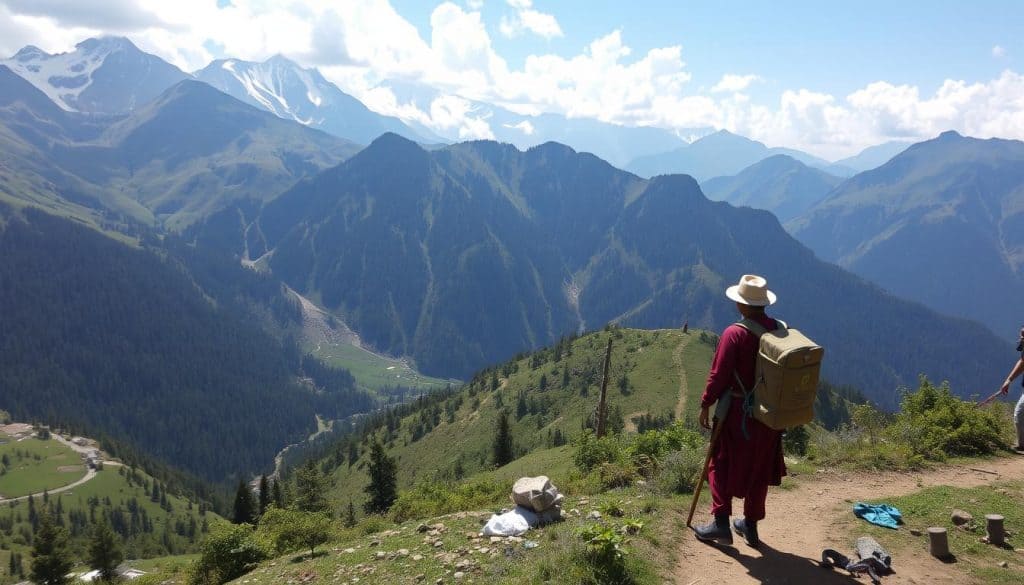
For experienced hikers, the Mugu Reconnaissance Trek in Nepal presents a unique challenge that combines remote terrain with high-altitude passes. This trek is highly recommended for experienced Himalayan travellers due to its sheer remoteness and lack of human contact, aside from the incredibly friendly locals.
Remote High-Altitude Challenges
The Mugu Reconnaissance Trek is characterized by its remote high-altitude terrain, which poses significant physiological challenges. Hikers must be well-acclimatized and possess excellent cardiovascular fitness to navigate the high altitudes, often for several days.
Crossing Multiple 5,000m Passes
Crossing multiple 5,000-meter passes is a hallmark of this trek, requiring hikers to be technically proficient and mentally tough. The passes demand excellent acclimatization and physical conditioning due to the low oxygen saturation levels. This challenging terrain includes numerous peaks and varied landscapes, making it a true test of hiking skills.
- Crossing multiple 5,000-meter passes on the Mugu Trek presents one of hiking’s greatest physiological challenges.
- The technical difficulty of these high passes varies with seasonal conditions, often requiring mountaineering skills.
- Weather conditions can change dramatically within hours, increasing the risk of hypothermia.
- The mental challenge of tackling consecutive 5,000-meter passes creates a unique psychological burden.
- Special permits are required for this remote region of Nepal, adding logistical complexity to an already challenging hikes expedition.
This trek stands out for its remote high-altitude challenges and the need to cross multiple 5,000-meter passes, making it a true adventure for seasoned hikers who are prepared to face the challenges that come with hiking at extreme feet elevations. With its demanding terrain and unpredictable weather, securing a permit is just the first step in planning this extraordinary expedition.
K2 Base Camp and Concordia: The Karakoram Challenge
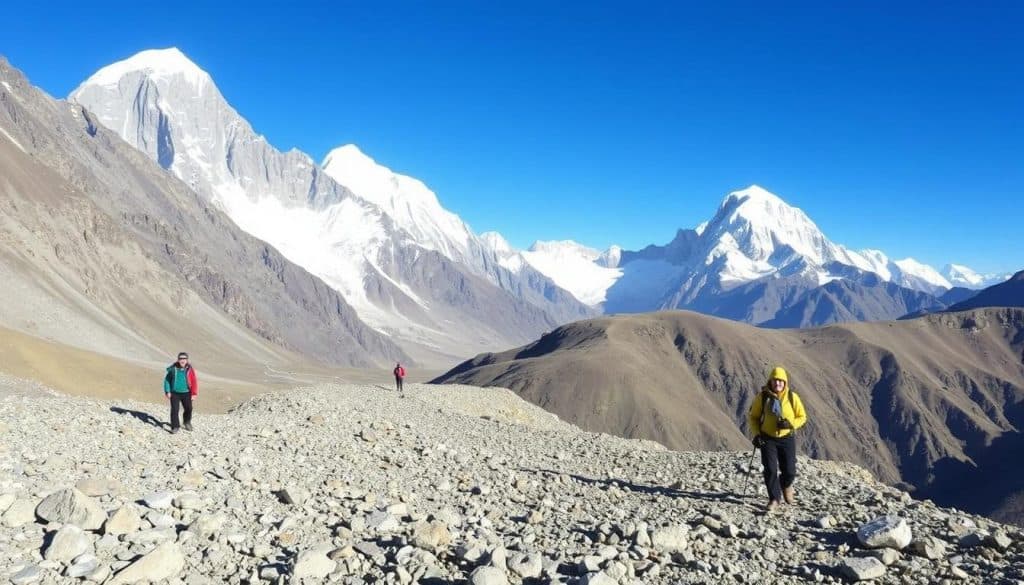
For experienced hikers, the K2 Base Camp and Concordia trek offers an unparalleled adventure. Nowhere else on earth can you stand so close to so many of the world’s highest peaks; as well as K2, you’ll be gazing up at Broad Peak (8,047m) and Gasherbrum (8,080m).
Treacherous Terrain and Unpredictable Weather
The K2 Base Camp trek is notorious for its challenging terrain and unpredictable weather conditions. Hikers must be prepared to face harsh elements, including steep ascents and descents, and rapidly changing weather patterns.
Technical Glacier Crossings
Technical glacier crossings are a significant aspect of this trek. The Baltoro Glacier, in particular, presents a constantly changing maze of ice formations, requiring hikers to adapt their route daily. Experienced hikers report that glacier travel on this trek is mentally exhausting, requiring constant vigilance and decision-making about route selection.
Proper gear selection becomes critical in this environment, with quality boots, gaiters, and trekking poles essential for safely navigating the mixture of loose rock, ice, and snow encountered throughout the journey. As you make your way through the challenging terrain, your experience and preparation will be put to the test, with many hikers finding it a true test of endurance, often walking many miles on foot, measuring the distance in thousands of feet.
Dhaulagiri Circuit Trek: Technical High-Altitude Adventure
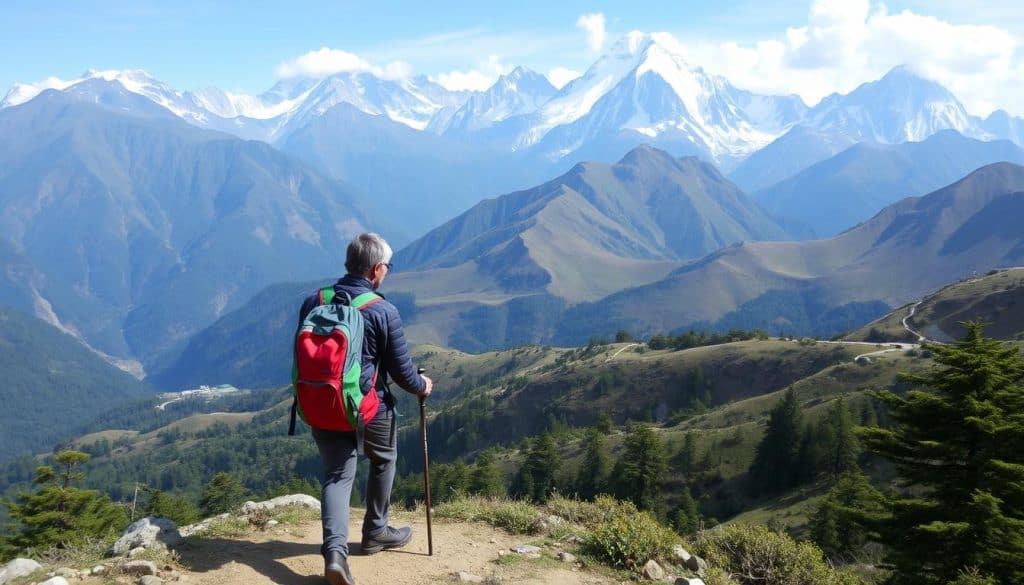
As one of the most technically demanding treks, the Dhaulagiri Circuit Trek requires meticulous planning and physical prowess. This trek is not for the faint of heart; it demands a high level of fitness and experience.
21 Days Above 5,000 Meters
The Dhaulagiri Circuit Trek is a prolonged exposure to high altitude, with hikers spending 21 days above 5,000 meters. This prolonged exposure can lead to altitude sickness if not managed properly. The trek involves traversing challenging terrain, including steep ascents and descents, and crossing high passes.
Self-Sufficiency in Extreme Conditions
Self-sufficiency is key on the Dhaulagiri Circuit Trek. Hikers need to carry all their gear, including food and fuel, as the trail is not well-traveled. The remote nature of this trek means that hikers must be prepared to handle medical emergencies independently. This includes carrying comprehensive first aid supplies and having knowledge of high-altitude illness management.
Planning is crucial, from managing food intake to ensure sufficient calories at high altitude to selecting the right gear for extreme conditions. Temperatures can drop well below freezing, requiring four-season tents and expedition-rated sleeping bags.
Hardergrat Trail: Switzerland’s Knife-Edge Ridge
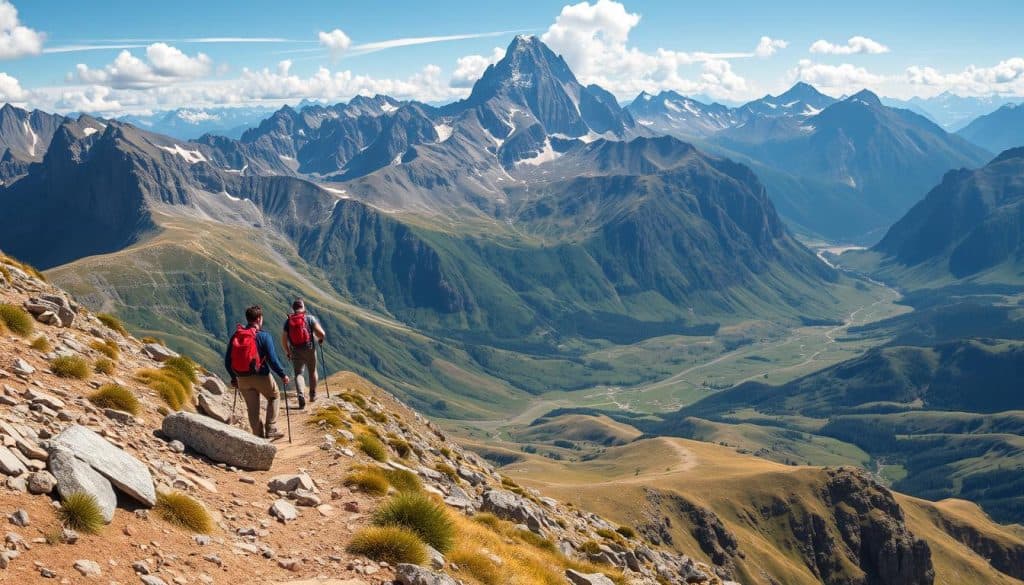
The Hardergrat Trail, or “Queen of the Alpine Ridges,” is a spectacular and challenging hike that runs along the ridge separating Lake Brienz and Lake Thun, offering breathtaking views of the surrounding mountains and valleys.
Exposed Ridgelines and Technical Terrain
The trail is approximately 27 kilometers long and features narrow ridges, steep drop-offs, and exposed sections, making it a technical hike that demands attention and skill. Hikers must navigate through terrain that can be daunting, with significant elevation changes and thousand-foot drops that require a good head for heights.
Mental Challenges of Exposure
The mental challenge of the Hardergrat often exceeds its physical demands. Maintaining focus for 10-12 hours a day while navigating the narrow ridge can be psychologically taxing. Many hikers report a unique sense of vulnerability due to the exposed nature of the trail and the considerable distance they must cover before reaching safety.
Chadar Trek: Walking on Frozen Rivers
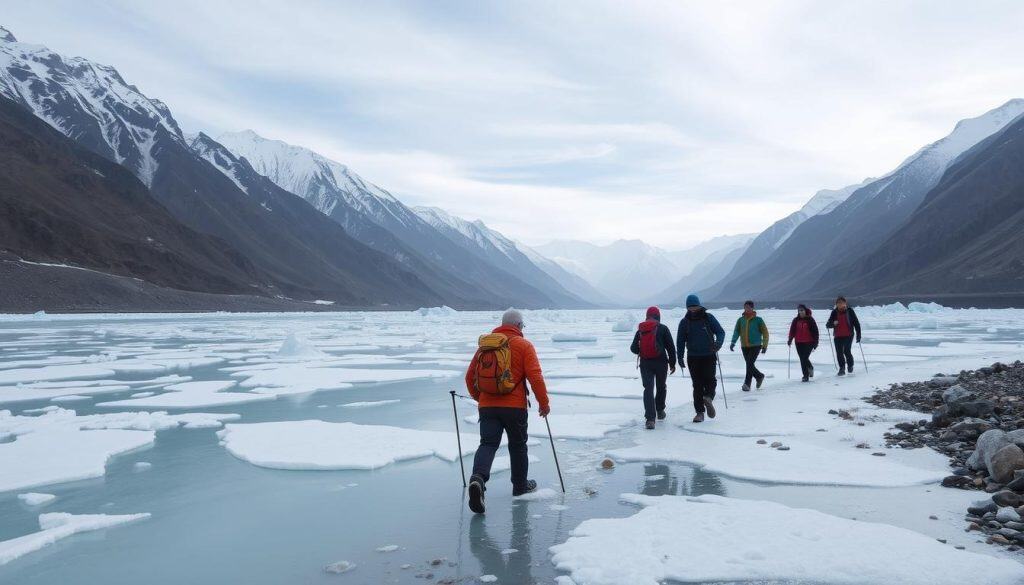
Imagine walking on a frozen river, surrounded by towering mountains and icy landscapes – welcome to the Chadar Trek. This difficult winter trek in the Zanskar region of Ladakh is considered one of the best treks in India.
Extreme Cold and Unpredictable Ice Conditions
The Chadar Trek is approximately 65 kilometers long and takes around 6 to 9 days to complete, with the entire journey at an altitude of over 11,000 feet. Trekkers face extreme cold and unpredictable ice conditions, making every step a challenge.
Limited Rescue Options
The remote Zanskar region offers extremely limited rescue options. In many sections, helicopter evacuation is not possible due to the narrow canyon walls and high altitude. Trekkers must be aware of the risks and sign comprehensive waivers acknowledging the limited rescue options before embarking on their journey.
To undertake this trek, one must be exceptionally self-sufficient and prepared for the distance and sections of the trek that pose significant challenges. Obtaining a permit requires acknowledging the inherent risks of this extreme environment.
What Makes These Hikes So Challenging
The world’s most challenging hikes demand more than just physical endurance; they require a combination of technical skills, mental toughness, and adaptability. When tackling these trails, hikers face a multitude of challenges that test their limits in various ways.
Altitude and Weather Extremes
High-altitude hiking poses significant challenges due to lower oxygen levels, extreme cold, and unpredictable weather patterns. For instance, the Dhaulagiri Circuit Trek involves spending 21 days above 5,000 meters, where hikers must contend with thin air, freezing temperatures, and potentially life-threatening storms.
Weather extremes can turn a challenging hike into a life-threatening adventure. Hikers must be prepared for sudden changes in weather, which can bring heavy snow, high winds, or intense heat, depending on the environment.
Technical Skills Required
The world’s hardest hikes often require a diverse technical skill set beyond standard hiking abilities. This includes rock scrambling, basic climbing techniques, and sometimes rope management for safety. For example, the Grand Canyon Thru-Hike involves technical scrambling, navigating exposed ledges, and climbing near-vertical pour-offs.
Other critical skills include navigation in unmarked terrain, river and glacier crossings, and assessing risks associated with these challenges. The combination of these technical requirements with fatigue, altitude effects, and weather challenges creates a compounding difficulty that exceeds the sum of individual technical obstacles.
Preparing for Extreme Hiking Challenges
Embarking on an extreme hiking adventure demands a comprehensive approach to preparation. As you gear up for the toughest trails, understanding the physical and logistical challenges is crucial.
Physical Training Requirements
Physical conditioning is the foundation of a successful extreme hiking expedition. You need to build endurance, strength, and agility to tackle the demands of long-distance hiking. A well-structured training plan should include cardiovascular exercises, strength training, and flexibility workouts. It’s essential to start training at least 6 months in advance to build up your stamina and mental toughness.
Essential Gear and Planning
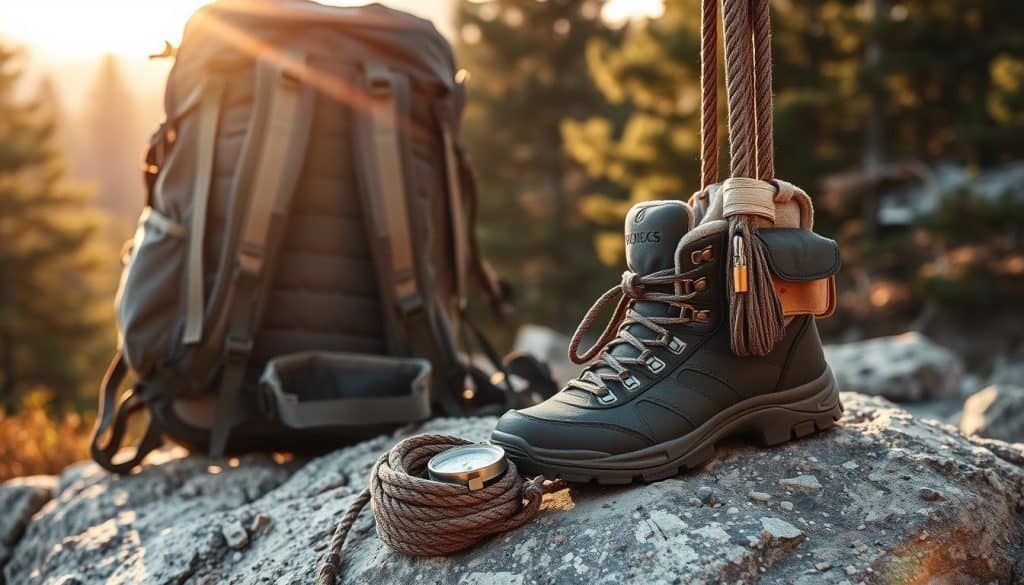
Once you’re physically prepared, the next step is to plan your expedition meticulously. This includes selecting the right gear, planning your food supplies, and obtaining the necessary permit. The right gear can make a significant difference in your comfort and safety on the trail.
| Category | Essential Items |
|---|---|
| Navigation | Map, Compass, GPS Device |
| Food | High-Calorie Snacks, Dehydrated Meals |
| Safety | First Aid Kit, Emergency Shelter |
Planning your way involves understanding the terrain, weather conditions, and potential hazards. With thorough preparation, you’ll be ready to tackle even the most challenging trails.
Conclusion: Embracing the World’s Toughest Trails
Embracing the world’s toughest trails means embracing a journey that tests your limits in every way. These extraordinary hikes offer a unique form of adventure that goes beyond ordinary hiking experiences, challenging participants on multiple levels and fostering profound personal growth.
As you’ve seen through our exploration of these incredible trails, from the Snowman Trek in Bhutan to the Hardergrat Trail in Switzerland, each journey presents its own set of challenges. The sense of accomplishment that comes from overcoming these obstacles is unparalleled.
These trails aren’t just about the physical challenge; they’re about the mental and emotional journeys that hikers undertake. The experience of completing such a journey can be life-defining, altering one’s perception of their capabilities and pushing their boundaries.
The diversity of these extreme hiking challenges around the world allows adventurers to progressively build their skills across different environments and technical requirements. This creates a lifetime journey of increasingly ambitious objectives.
In conclusion, while these trails represent the pinnacle of hiking difficulty, they remind us that adventure is personal. Each hiker must find the challenges that push their boundaries while respecting their abilities and experience level.
FAQ
What should I consider when planning a challenging hike like the Snowman Trek or K2 Base Camp?
When planning a challenging hike, consider factors such as physical conditioning, technical skills required, weather conditions, and necessary gear. It’s also essential to research the trail conditions, permits required, and potential risks involved.
How do I prepare physically for extreme hiking challenges like the GR20 or Dhaulagiri Circuit Trek?
To prepare physically, start training at least 6-12 months in advance with a mix of cardiovascular exercises, strength training, and endurance building activities. You should also acclimate yourself to high altitudes if necessary.
What kind of gear is essential for high-altitude treks like the Mugu Reconnaissance Trek?
Essential gear includes sturdy hiking boots, layers for varying weather conditions, a first aid kit, navigation tools, and a reliable means of communication. For high-altitude treks, crampons and ice axes may also be necessary.
Are technical skills required for hikes like the Hardergrat Trail or Chadar Trek?
Yes, technical skills are required for hikes like the Hardergrat Trail or Chadar Trek. The Hardergrat Trail involves exposed ridgelines and technical terrain, while the Chadar Trek requires walking on frozen rivers with unpredictable ice conditions.
How do I manage the risk of altitude sickness on high-altitude treks?
To manage altitude sickness, ascend gradually to allow acclimatization, stay hydrated, and monitor your body’s response to high altitude. It’s also crucial to recognize the symptoms of altitude sickness and take action promptly if they occur.
What’s the best way to plan for unpredictable weather on challenging hikes?
Plan for unpredictable weather by researching typical weather patterns for the time of year you’ll be hiking, packing layers and waterproof gear, and staying informed about weather forecasts during your trip.