
Imagine embarking on a journey that spans thousands of miles, traversing some of North America’s most breathtaking landscapes. For many hikers, completing the Triple Crown of Hiking is a lifetime achievement, with only about 700 individuals having finished all three trails.
The Appalachian Trail (AT), Pacific Crest Trail (PCT), and Continental Divide Trail (CDT) are the most iconic long-distance trails in the United States, offering unique experiences and challenges. Spanning over 7,700 miles, these trails take hikers through diverse geographic regions, from the eastern United States to the western edge and the Rocky Mountains.
As someone who’s passionate about hiking, I’m excited to share with you the significance of these trails and what makes them so special. Whether you’re an experienced hiker or just starting to plan your adventure, understanding the trail options is crucial.
Key Takeaways
- The Big 3 trails in the USA are the Appalachian Trail, Pacific Crest Trail, and Continental Divide Trail.
- Completing all three trails is known as the Triple Crown of Hiking, achieved by about 700 hikers.
- The total distance of the three trails is approximately 7,700 miles.
- Each trail offers a unique hiking experience, spanning different geographic regions.
- Thru-hiking these trails typically takes 5-7 months to complete.
The Triple Crown of American Hiking
Achieving the Triple Crown is a remarkable feat that signifies a hiker’s ability to tackle the most iconic trails in the United States. This prestigious achievement is not just about completing three long-distance trails; it’s about the journey, the challenge, and the personal growth that comes with it.
What are the Big 3 trails USA?
The Big 3 trails USA refer to the Appalachian Trail, the Pacific Crest Trail, and the Continental Divide Trail. These three trails are considered the most iconic long-distance hiking trails in the United States, each offering unique landscapes and challenges. Together, they span over 7,700 miles, taking hikers through diverse terrains and ecosystems.
Completing all three trails is a significant undertaking that requires careful planning, physical endurance, and mental toughness. It’s an adventure that pushes hikers to their limits, testing their resolve and resilience.
The Triple Crown Achievement
Becoming a Triple Crowner is an incredible achievement that is recognized by the hiking community. As of now, only about 700 people have been recognized by the American Long Distance Hiking Association – West for completing the Triple Crown. One such notable hiker is Heather “Anish” Anderson, who completed the Triple Crown three times and became the first woman to achieve a calendar-year Triple Crown in 2018.
The Triple Crown achievement is not just about the number of miles hiked; it’s about the experience, the knowledge gained, and the connection to the natural world. It’s a testament to the hiker’s dedication and perseverance. As “The journey of a thousand miles begins with a single step,” the journey of the Triple Crown begins with the decision to take on the challenge.
The Appalachian Trail: America’s First Long-Distance Trail
As America’s first long-distance trail, the Appalachian Trail offers a unique blend of natural beauty, challenging terrain, and rich history. Spanning over 2,190 miles from Springer Mountain in Georgia to Mount Katahdin in Maine, it passes through 14 states, presenting a significant adventure for any hiker.
Trail Overview and History
The Appalachian Trail was the brainchild of forester and conservationist Benton MacKaye, proposed in 1921 and completed in 1937. It became an official national scenic trail in 1968. The trail is maintained by more than 30 trail clubs and partners, managed by the National Park Service, U.S. Forest Service, and the nonprofit Appalachian Trail Conservancy. With a rich history and diverse landscapes, the Appalachian Trail is an adventure like no other, attracting hikers from all over the world.
The trail’s history is not just about its creation but also about the community that has formed around it. Thousands of hikers attempt to thru-hike the trail every year, each with their own story of adventure and perseverance.
Terrain and Challenges
The trail is known for its rolling terrain, often referred to as the “green tunnel” due to its predominantly forested route. However, the cumulative elevation gain and loss over the course of a full thru-hike is equivalent to climbing Mount Everest 16 times, totaling about 464,000 feet. The highest point on the trail is Clingmans Dome in Tennessee’s Great Smoky Mountains National Park, standing at 6,643 feet, while the lowest point is in Bear Mountain State Park in New York at 124 feet.
Hikers face numerous challenges on the Appalachian Trail, including physical demands, weather variations, and the mental challenge of maintaining motivation through dense forests where views can be limited. The terrain varies significantly, with steep climbs and descents, rocky paths, and potentially hazardous weather conditions.
Highlights and Must-See Sections
One of the standout sections of the Appalachian Trail is the stretch through the Great Smoky Mountains National Park, where hikers are treated to panoramic views of mist-covered valleys and hemlock forests. Another favorite among hikers is the White Mountains of New Hampshire, known for their challenging, steep terrain that requires good scrambling skills.
- McAfee Knob, one of the most photographed spots on the trail, offers breathtaking views.
- The Roan Highlands are known for their beautiful balds and stunning vistas.
- The rugged terrain of Maine is a test of endurance and resilience for thru-hikers.
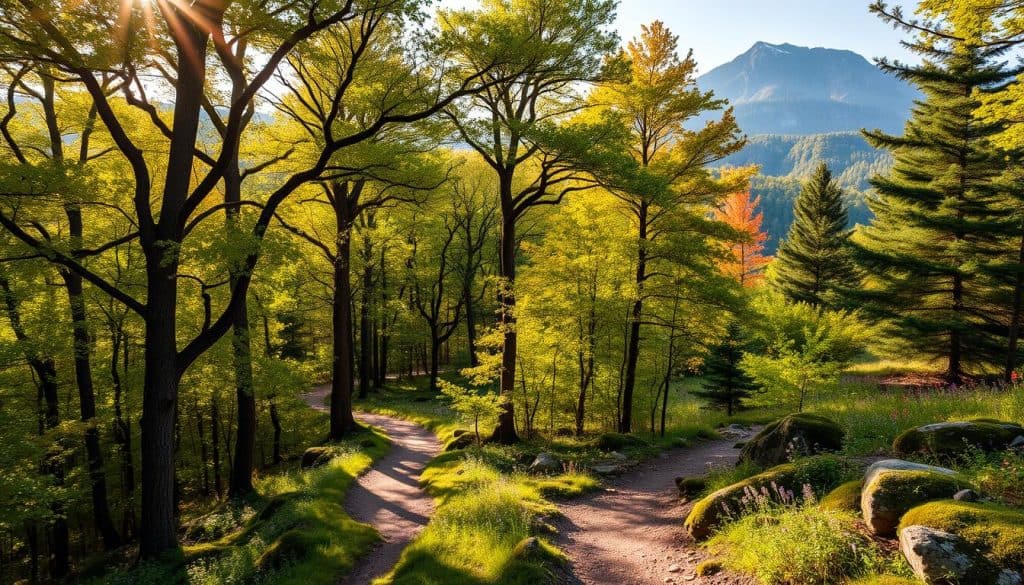
Each section of the trail has its unique charm and challenges, making the Appalachian Trail a diverse and exciting adventure for hikers.
The Pacific Crest Trail: From Desert to Alpine Wilderness
Spanning over 2,650 miles, the Pacific Crest Trail is more than just a hiking trail; it’s an adventure across diverse landscapes. As you embark on this journey from the Mexican border to the Canadian border, you’ll experience a wide range of ecosystems and challenges.
Trail Overview and History
The Pacific Crest Trail (PCT) stretches through California, Oregon, and Washington, offering hikers a unique experience. The trail was first proposed by Catherine Montgomery in 1926 and later championed by Clinton C. Clarke from the 1930s into the 1950s. It was designated as a national scenic trail in 1968, the same year as the Appalachian Trail. The PCT’s highest point is Forester Pass in California, reaching an elevation of 13,200 feet.
Ninety-five percent of thru-hikers begin their journey at the southern trailhead near Campo, California, and conclude at Manning Provincial Park in British Columbia. This direction allows hikers to tackle the more challenging sections, such as the Sierra Nevada mountain range, when they are more physically conditioned.
Diverse Ecosystems and Landscapes
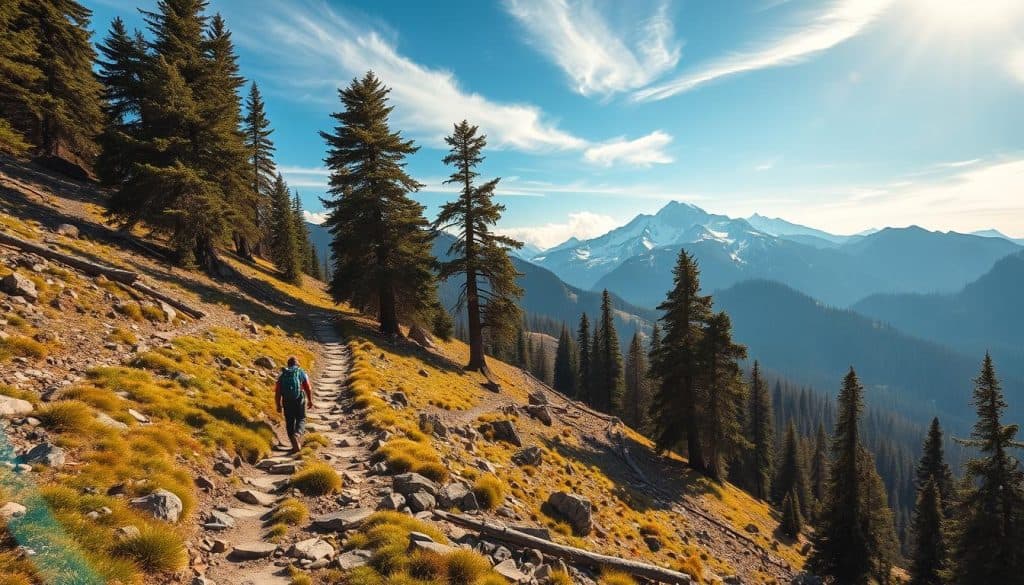
The PCT is renowned for its diverse ecosystems, ranging from the scorching Mojave Desert in Southern California to the alpine wilderness of the Sierra Nevada and the lush forests of the Cascade Range. Hikers will experience extreme temperature variations, high altitude sections, water scarcity in desert areas, and challenging snow navigation in the mountains.
As you hike through these varied landscapes, you’ll encounter unique flora and fauna. The Sierra Nevada portion, in particular, is considered the “real jewel of the trail” due to its granite peaks, alpine lakes, and meadows blanketed with wildflowers.
Highlights and Must-See Sections
The Pacific Crest Trail offers numerous highlights and must-see sections. The Sierra Nevada portion is a standout, with its granite peaks and alpine lakes. Other notable sections include the volcanic landscapes of Northern California and Oregon, the desert landscapes of Southern California with their unique flora, Crater Lake National Park in Oregon, and the remote North Cascades in Washington.
As Thomas, a seasoned hiker, notes, “The PCT has big vistas; the views along the entire trail are really, really stellar.” Whether you’re drawn to the desert landscapes, mountain vistas, or lush forests, the Pacific Crest Trail has something to offer every hiker.
The Continental Divide Trail: America’s Most Remote Challenge
As one of the Triple Crown trails, the Continental Divide Trail offers an unparalleled wilderness experience, testing hikers’ endurance and resolve. The Continental Divide Trail (CDT) is a monumental undertaking, covering about 3,100 miles from the Mexican border to the Canadian border.
Trail Overview and History
The CDT traverses through five states: Montana, Idaho, Wyoming, Colorado, and New Mexico, following the Continental Divide along the Rocky Mountains. The first section of the trail was proposed and established in Colorado in 1962, with the CDT being formally established in 1978. As Thomas notes, “Most people will choose to tackle the CDT after they have a little bit more trail experience, just because you’re so out there.” This sentiment underscores the trail’s challenging nature.
The trail’s history is marked by its gradual development, with parts still being completed and rerouted. This ongoing evolution adds to the trail’s rugged charm and challenge.
Wilderness Experience and Navigation Challenges
The CDT is renowned for its remoteness and the high level of self-sufficiency required to tackle it. Hikers must be prepared for extreme weather conditions, difficult navigation, and the psychological challenge of being in true wilderness isolation. The trail includes sections that follow established paths, dirt roads, and sometimes require cross-country navigation without a defined trail.
Navigation Challenges are a significant aspect of the CDT. Hikers need to be skilled in using maps, compasses, and GPS devices to stay on track. The trail’s remote nature means that rescue can be difficult and time-consuming, making preparation and self-reliance crucial.
Highlights and Must-See Sections
The CDT is dotted with breathtaking landscapes and unique features. Highlights include Wyoming’s Wind River Range, Montana’s Glacier National Park, Colorado’s San Juan Mountains, and New Mexico’s Gila Wilderness. Each of these sections offers hikers a distinct and unforgettable experience, from the stunning mountain vistas to the historic cliff dwellings and hot springs.
One of the most notable features of the CDT is its highest point, Gray’s Peak, which stands at 14,270 feet, making it the highest point on any national scenic trail. This elevation, combined with the trail’s overall high average elevation, contributes to the challenging conditions hikers face.
In conclusion, the Continental Divide Trail is a true adventure for those seeking a challenge. Its remote nature, combined with the physical and mental demands of long-distance hiking, make it a journey that requires careful preparation and a strong resolve.
Comparing the Big 3 Trails: Which One Is Right for You?
When considering a thru-hike of one of America’s Big 3 trails, the decision can be daunting due to the unique characteristics of each trail. To make an informed decision, it’s essential to compare the difficulty levels, community experiences, and support systems available on the Appalachian Trail (AT), Pacific Crest Trail (PCT), and Continental Divide Trail (CDT).
Difficulty and Technical Challenges
Each of the Big 3 trails presents its own set of challenges. The AT is known for its relentless ups and downs, often referred to as “the roller coaster.” In contrast, the PCT poses high altitude challenges, while the CDT is characterized by its remoteness and navigation difficulties.
| Trail | Difficulty Level | Technical Challenges |
|---|---|---|
| AT | Moderate to Strenuous | Relentless ups and downs |
| PCT | Strenuous | High altitude challenges |
| CDT | Very Strenuous | Remoteness and navigation |
Community and Support Systems
The community experience varies significantly across the three trails. The AT is known for its strong trail community and frequent town stops, making it a more social experience. The PCT offers a balance between solitude and community, while the CDT provides a more solitary wilderness experience.
As Thomas notes, “The AT is a bit more about community and meeting people along the way… The PCT has big vistas, and the views along the entire trail are really, really stellar.” For those considering the CDT, Thomas advises that “most people will choose to tackle the CDT after they have a little bit more trail experience, just because you’re so out there.” For more information on preparing for the CDT, check out this guide to the CDT.
Best Trail for Beginners vs. Experienced Hikers
For beginners, the AT is often recommended due to its frequent resupply points and established support system. Experienced hikers, on the other hand, may prefer the PCT for its scenic views or the CDT for its challenging remoteness.
By considering these factors and understanding the unique characteristics of each trail, hikers can make an informed decision about which Big 3 trail is right for them.
Preparing for a Big 3 Trail Thru-Hike
Preparing for a Big 3 trail thru-hike involves more than just packing gear; it demands a comprehensive approach that includes physical and mental preparation, careful gear selection, and meticulous logistics planning.
Physical and Mental Preparation
Physical preparation is crucial for tackling the Big 3 trails. Hikers should start training at least 3-4 months in advance, building up their endurance with regular hiking and cardiovascular exercises. Mental preparation is equally important; hikers need to develop strategies for coping with isolation, managing stress, and maintaining motivation over several months on the trail.
For instance, hikers preparing for the Pacific Crest Trail (PCT) should focus on building their endurance for long desert stretches and snow-covered mountain passes.
Gear Considerations for Each Trail
Gear selection varies significantly across the Big 3 trails. For the Appalachian Trail (AT), hikers need to prioritize rain gear and comfortable footwear. The PCT demands equipment for desert and snow conditions, including a reliable water filtration system and crampons for icy sections. The Continental Divide Trail (CDT) requires robust navigation tools and bear safety equipment due to its remote nature and grizzly bear country.
| Trail | Essential Gear |
|---|---|
| Appalachian Trail (AT) | Rain gear, comfortable hiking boots |
| Pacific Crest Trail (PCT) | Desert gear (sunscreen, wide-brimmed hat), snow equipment (crampons, ice axe) |
| Continental Divide Trail (CDT) | Navigation tools (compass, maps), bear safety (bear spray, bear canister) |
Logistics and Planning Tips
Logistics planning is vital for a successful thru-hike. This includes obtaining necessary permits, especially for the PCT, planning resupply points, and budgeting for the duration of the hike. Hikers should also consider the timing of their hike to avoid extreme weather conditions.
By carefully planning and preparing, hikers can ensure a successful and enjoyable Big 3 trail thru-hike.
Conclusion: The Enduring Legacy of America’s Big 3 Trails
The Big 3 trails have left an indelible mark on American hiking culture, shaping the way we experience and interact with nature.
These trails offer more than just a physical journey; they provide transformative experiences that change hikers’ perspectives on nature, themselves, and their capabilities.
As the number of hikers continues to grow, so does the importance of preserving these national treasures. From the Sierra Nevada to the desert landscapes, these trails span across various terrains and national parks, offering breathtaking views and challenging terrain.
Whether you’re a seasoned hiker or just starting out, we encourage you to experience these trails, whether through day hiking, section hiking, or supporting trail maintenance efforts.
FAQ
What are the three trails that make up the Triple Crown of American Hiking?
The three trails are the Appalachian Trail, the Pacific Crest Trail, and the Continental Divide Trail. Completing all three is considered a significant achievement among long-distance hikers.
How long is the Pacific Crest Trail?
The Pacific Crest Trail is approximately 2,650 miles long, stretching from the California-Mexico border to the Washington-Canada border.
What is the highest point on the Continental Divide Trail?
The highest point on the Continental Divide Trail is Grays Peak in Colorado, which stands at 14,270 feet above sea level.
How many states does the Appalachian Trail pass through?
The Appalachian Trail spans 14 states, from Georgia to Maine, covering a diverse range of landscapes and ecosystems.
What kind of terrain can hikers expect on the Big 3 trails?
Hikers can expect varied terrain, including desert landscapes, mountainous regions, and wilderness areas, with challenges such as elevation gain, inclement weather, and remote sections with limited access to amenities.
How long does it typically take to complete a thru-hike of one of the Big 3 trails?
The time it takes to complete a thru-hike can vary significantly depending on the trail, the hiker’s experience, and their daily mileage goals, but it typically takes several months to complete.
What are some essential gear considerations for hikers tackling the Big 3 trails?
Hikers should consider gear such as sturdy hiking boots, comfortable backpacks, water filtration systems, and layers for varying weather conditions, as well as personal safety items and navigation tools.
Are the Big 3 trails suitable for beginners?
While it’s possible for beginners to attempt one of the Big 3 trails, it’s generally recommended that hikers have significant backpacking experience and physical conditioning before embarking on a thru-hike.